Saturday, May 10, 2014

Stewards of the Land: Siegfried vs Rodale

Johannes and Elizabeth Siegfried were my maternal sixth great grandparents

I recall my father speaking from time to time of Rodale Insitute. I vaguely knew that they had something to do with new gardening methods, and that Dad would sometimes buy their seeds or try a new technique; sometimes he was pleased, sometimes not.

I didn’t realize that Rodale was a local institution until I changed the route I took between Maryland and Catasauqua and regularly drove Route 222. Near Maxatawny, PA, I saw signs pointing to Rodale.


Decorative wrought iron gate bears the name John Siegfried, a descendant of the original settler.


Imagine my surprise when I was researching the Siegfrieds, a new-found set of ancestors, and saw a reference to Rodale! Last spring, my brother Bill and I stopped in on a whim, before I was even quite sure what our connection was. We were warmly welcomed and offered the opportunity to take a self-guided tour.


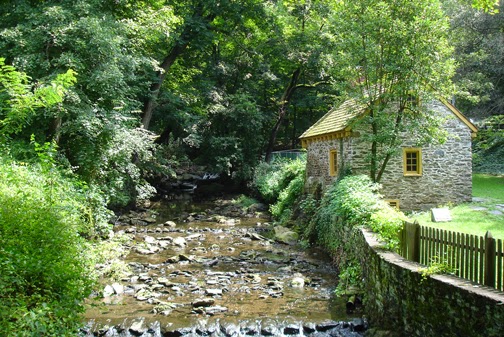
Bill inspects the spring house, which dates to 1790.


It turns out that my first Siegfried immigrants were Johannes and Elizabeth Siegfried. They were reportedly Mennonites and may have been from either Germany or Switzerland. Arriving in Philadelphia in 1719, they initially settled in Oley, Philadelphia County (now Berks). About 1724, (1) Johannes purchased large tracts of land in “Mach-set-Hanne” (Maxatawny), accumulating 600 acres before his death in 1747. At that time he split the land between his two sons, John and Joseph. Siegfrieds remained on the “Siegfried’s Dale” property for over 200 years. In 1971 it was purchased by the Rodales. (2)

J. I. Rodale was the father of organic farming in this country. It was said he had an almost missionary zeal. In 1971, when J.I. Rodale died, his son Robert took over and expanded the agriculture/health-related business with the purchase of the Siegfried farm. After more than 200 years of the Siegfried’s stewardship, the farm was worn out. The Rodales have since used the property for large-scale research using organic and self-sustaining farming methods. Today the farm has been rejuvenated and is the site of the “Rodale Institute.”


The plaque on this home is dated 1827.


What is wonderful is that the Rodale spirit of rejuvenation and preservation has extended to the Siegfried farm. The buildings on the property-- homes, barns, a springhouse, and a schoolhouse--have been maintained and the site is listed on the National Register of Historic Places as “Siegfried’s Dale Farm.” Visitors are welcome to the property for a planned or self-guided tour. As Siegfried descendants we received a warm greeting.
One of the homes in this grouping also dates to 1790.

As to my direct ancestors, Johannes died on the farm in 1747 after living on his land for over 20 years. His wife Elizabeth lived another 20 years, with her death coming in 1767. Although no markers remain, they were buried in the Siegfried family cemetery, which is located on the property and can be visited.


The Siegfried Family Cemetery is on the property and can be visited. It definitely needed a mowing when we visited in May 2013!

Their oldest child (and my fifth great grandmother), Catherine Siegfried, was born in Oley in 1719 shortly after their arrival in this country. On Christmas Day, 1737, she married Johann Frederick Romich (Romig) and left the family farm. My family follows this line of descent.

The oldest buildings remaining on the property date from 1790, which means that none of my ancestors actually lived in them. However, homes were rebuilt on the same sites, located over springs so that fresh water was protected from possible raids and easily accessible during the winter.  So when you walk the grounds, you are walking where my family's ancestors walked and enjoying the same rolling landscape.

One of the whimsical touches on the Rodale Institute property


(1) William Penn had been given title to the land by the English crown, but he didn’t actually purchase it from the Lenni Lenape until 1732. Therefore some records date the first Siegfried deed to 1732, about eight years after he took possession.

(2) Descendants of Johannes and Elizabeth Siegfried are indebted to Leon Borst, who published The Siegfrieds of Siegfried's Bridge.

Saturday, May 3, 2014

Preserving What’s Now for Then


In the last years of her life, my mother, Eleanor Manning Stine, quietly went about preserving the family history for the future. She collected memorabilia into a central file cabinet, labeled photos (sometimes incorrectly), and organized family letters dating back to the 1940s. 
Sally, Ed, and Peg Manning when they briefly lived in Detroit!

She did all of this without making a big deal about what she was doing. We knew there were things in the file cabinet but she didn’t make a point of pulling them out and sharing them with us.

It was an amazing treasure trove when we went through it.

Letter from Mom to her gang at home during WWII.
I wish, though, that she had pulled us in. I wish had taken the time before she passed away to talk with her about her family. But so often when we visited, we were busy with holidays and families. In making new memories and dealing with day-to-day events, so many old memories were lost.


After Mom died, we started to ask my father more questions. What a joy! Dad didn’t volunteer stories often, but when we got rolling he might drop a bombshell, like saying, “Well, of course, there was the time your mother moved out on me,” or “Well maybe that’s when I almost died when I was a kid.” We would explode with laughter and amazement and demand details. But think of the stories we missed by not starting sooner!
I asked Dad why he missed so much school in sixth grade

I never knew either of my grandfathers. Dad’s father, Titus William Stine, died in a railroad accident just before Christmas in 1946. Dad had married in 1944, entered the service, and traveled around the country with his new bride for two years during the war. He was anticipating with pleasure getting to know his father as a grownup when he returned. He said his father was not always the best provider, but he was a lot of fun to be with. Clearly Dad thought he was a good man. 
 
Titus Stine is on the left in this humorous postcard.
We drove to some of the places they had lived, but as I try to write stories about my forebears, I realize there is so little I know, and so much I could have asked.

 
Dad lived in 516 Locust, Bethlehem briefly. 514 Locust was a bakery!

Even more of an unknown is Mom’s father, William Traver Manning. Coincidentally he also died during the war, in 1945, but from a heart condition. Ironically we have many letters written by and to Mom’s family members, her mother's memoirs, her brother's memoirs, and an extensive history about William’s father, E. B. Manning, but very little picture of what "Bill" was like has emerged. We know where when he was born, where he lived, for whom he worked, and even who introduced him to his future wife, May Strouse. We also know that he practiced the trade of electrical engineer from a very young age, building an electrical generator contraption that provided electricity for his father's home before anyone else in the area had it. But we don’t know if he was funny or stern or what his hobbies might have been. Was he as involved in radios as his son Ed?

 
William Traver Manning, 1916

As I write this, I have three great nieces and one great nephew. That means I personally knew two of their great grandparents (my Mom and Dad) and two of their great great grandparents (my two grandmothers). How I would love to have heard stories about what my great grandparents and great grandparents were like! I am so glad that we have photos (and not just digital ones that can be lost in the ether) to show them that Mom held Immy, and that Dad met Immy, Julia, Oliver, and Avery in turn and had a chance to see their personalities start to emerge. But without all of us preserving their stories, they will be as much a mystery to them as my forebears are to me!
Mom and Dad with first great grandchild, Imogen Edwards


Dad enjoys his four great grandchildren

Saturday, April 26, 2014

Frank Strouse, Civil War Soldier


Frank Strouse was my maternal GG Grandfather

I recently visited the Gettysburg battleground. Prior to getting deeply involved in genealogy, I vaguely knew that my maternal GG grandfather, Frank Strouse, served there but knew very little else. Other than telling one funny story, he did not talk to his family about the war. I took the opportunity of preparing for this Gettysburg trip to put more pieces together. Following is what I learned.
 
Pottsville ca 1861. John Warner Barber & Henry Howe,Our Whole Country or the Past and Present of the United States....Volume I (New York: Tuttle & McCauley, 1861), 538

Prior to the Civil War, Pottsville had a longstanding National Light Infantry unit. When President Lincoln issued a call to protect Washington, this unit was among the First Responders. Frank Strouse was not among this initial unit, but at the end of their three months tour of duty, when nearly all of the former National Light Brigade members signed a three-year/duration of the war contract, Frank Strouse and other Pottsville citizens joined them. They became Company A of the newly authorized 96th Pennsylvania Infantry. Organized right in Pottsville in September, 1861, the unit served in many of the bloodiest fights of the war, finally mustering out after the Battle of Cedar Creek in September, 1864.


Gettysburg is only one of the many battles in which the 96th was engaged. When I reviewed the service record for the unit, I could understand why he might have chosen not to talk about what he must have witnessed and endured. Following is a partial list of their campaigns and battles:

 
Image from Gettysburg Cyclorama

1862

First Battle of Manassas

Siege of Yorktown

Seven Days Battles before Richmond

Gaines' Mill

Maryland Campaign

Antietam

Battle of Fredericksburg

1863

Burnside's second Campaign, "Mud March"

Chancellorsville Campaign.

Maryes Heights, Fredericksburg

Battle of Gettysburg

Bristoe Campaign

Mine Run Campaign

1864

Rapidan Campaign

Battle of the Wilderness

Siege of Petersburg

Repulse of Early's attack

Sheridan's Shenandoah Valley Campaign

Battle of Opequan, Winchester

Battle of Cedar Creek

 
Gettsyburg Battlefield Day 2 (July 2)

With specific reference to Gettysburg, the 96th was part of the Sixth Corps commanded by John Sedgwick. The rigorous march they made to Gettysburg earned them the nickname “Sedgwick’s Foot Cavalry.” I had believed that the 96th was held in reserve but that was not exactly true, and certainly was not consistent with the position of their monument on the field. A little more research revealed that when they reached the battlefield the afternoon of July 2nd, Longstreet was in the process of driving Sickles from his position. The men were at once formed, with no rest, to join the battle and wound up to the right and front of Little Round Top. They took position behind a stone fence and held the position with slight loss until end of the battle.

 
Monument marks the position of the 96th near Little Round Top

The 96th is commemorated with a monument of a prone soldier at the point where they were positioned, and also with a plaque on the huge domed Pennsylvania State Monument, which names every man who fought for Pennsylvania at Gettysburg.

 
The domed Pennsylvania Monument at Gettysburg.

Closeup of 96th Infantry plaque. Frank Strouse is a private in Company A.


Frank Strouse’s descendants can be proud of his service during the Civil War. We can also count ourselves lucky that he survived the war to marry his sweetheart, Sarah Jane Bast!
Memorial Stone at Highland Park Cemetery in Allentown


For more information you may want to read the History of the 96th Pennsylvania.

Saturday, April 19, 2014

Dad’s Got Ancestors! Wilhelm Rittenhouse, the Paper Maker


My Rittenhouse ancestors are from my paternal Smith line. 
Wilhelm Rittenhouse was my 9th great grandfather.

My mother’s maternal line was very well established, so I was frustrated when initial research into my father’s paternal (Stine) line did not yield results. I turned instead to his Smith antecedents and within short order excitedly emailed my family saying, “Dad’s Got Ancestors!” I had discovered the Rittenhouse family.

Wilhelm Rittenhouse
Wilhelm Rittenhouse (1644-1708) is arguably my most famous immigrant ancestor. He built the first paper mill in the British North America and the mills run by his extended family held a virtual monopoly on paper making for about 40 years. Many of the important colonial documents of that period were printed on paper sporting a Rittenhouse watermark. The family-owned business continued to make paper for 150 years.

Wilhelm Rittenhouse was born in 1644 in a small village outside of Mühlheim on the Ruhr River in Germany. He probably learned the paper making trade in his home village, then followed an aunt and uncle to the Netherlands where they operated a paper mill. He lived in the Netherlands for over 20 years, taking the citizen’s oath in 1679. He married a Dutch woman, Geertruid Pieters, in 1665, and their three children -- Nicholas or Claus, Gerrit, and Elisabeth -- and were all born in the Netherlands. The family papermaking business expanded and Wilhelm learned all parts of the business.
 
1690 homestead, now serving as the kitchen/bakery
It isn’t known why Wilhelm relocated his family, including the three children, to Pennsylvania in 1688. William Penn presented a very attractive vision for his new colony, including business opportunities and religious freedom. While in Amsterdam, Wilhelm became a Mennonite, and although no longer persecuted for their beliefs in the Netherlands, many Mennonites joined with Quakers to move to Pennsylvania. Wilhelm brought a good skill set to the colonies, including the ability to negotiate, speak multiple languages, build mills, and make paper.

By the summer of 1889 Wilhelm had several town lots in the new Germantown settlement, but by the fall of 1890 he had leased acreage on a tributary of the Wissahickon Creek in preparation to build a paper mill. This acreage eventually formed Rittenhouse Town.

One of Wilhelm’s partners in this venture was William Bradford, who had an established printing business with a government contract. In exchange for financing, Bradford held a monopoly on much of the paper mill’s output for a number of years.

Paper making fit nicely into the colony’s economy. At this time, paper was made from cloth rags. William Penn promoted the growing of flax to make into cloth; the cloth in turn became rags for paper. This early “green” economic system is described in the first poem published in Pennsylvania, Richard Frame’s 1692 poem A Short Description of Pennsilvania excerpted below.

The German-Town, of which I spoke before,
Which is, at least, in length one Mile and More,
Where lives High-German People, and Low-Dutch,
Whose Trade in weaving Linnin Cloth is much,
There grows the Flax, as also you may know,
That from the same they do divide the Tow;
….
A Paper Mill neare German-Town doth stand,
So that the Flax, which first springs from the Land,
First Flax, then Yarn, and then they must begin,
To weave the same, which they took pains to spin.
Also, when on our backs it is well worn,
Some of the same remains Ragged and Torn;
Then of those Rags our Paper it is made,
Which in process of time doth wate and fade:
So what comes from the Earth, appeareth plain,
The same in Time returns to Earth again.


About 1700 a devastating flood wiped out the original paper mill, and a new improved one was built, this time without Bradford financing. At last Wilhelm was free to expand his customer base and reputation.

1707 Homestead
On the personal side, while Mennonites were free to practice their religion in Pennsylvania, there was more support for the Quaker establishment and some Mennonites converted. Those who stayed true to their Mennonite beliefs, including Wilhelm and his family, began meeting in homes in 1690. However, there was no official minister or deacon until 1698 when Wilhelm reluctantly agreed to serve in that capacity. 
 
1770 meetinghouse that replaced 1708 log structure

Unfortunately, ministers could not baptize or celebrate communion. In 1702 the colonials begged Europe for an ordained bishop to be sent to the colony, but the trip was considered too arduous, so they were told to prayerfully choose a bishop from their midst. Eventually Wilhelm overcame his misgivings and agreed to serve as the first bishop in British North America. Before he could celebrate either rite, he died unexpectedly, so historians agree he cannot technically have been considered a bishop. Nevertheless, he is credited with having made arrangements before his death to have the Mennonite meetinghouse in Germantown constructed.

Stone with initials and 1707 date
Wilhelm’s son Claus or Nicholas (1666-1734) was his partner in the paper mill and took over the business on Wilhelm’s death.  Claus, in turn, prepared his son William Dewees Rittenhouse (1691-1772) to inherit the mill. William Dewees was the last of my line to own the mill; he bequeathed the mill to his son Jacob. I am descended from two other sons of William, Nicholas and (probably) Henry. [Note that I am NOT a descendant of the well-known David Rittenhouse, who was a cousin.]


Oldest part of home built for William D Rittenhouse
I feel somewhat awestruck to have Wilhelm Rittenhouse as an ancestor. When I studied Pennsylvania history in school, names like William Penn and Benjamin Franklin seemed far removed. That makes it startling to read that William Penn took a personal interest in seeing that Wilhelm’s paper making business got back on its feet after the 1700 flood, and to read that that Benjamin Franklin preferred to print on Rittenhouse paper. Think of the words and ideas that were expressed on that paper! I was delighted to find that Historic Rittenhouse Town is not only a National Historic District, but that two of Wilhelm’s homes have survived, a small building built in 1690 which now serves as a bakery and a larger homestead dated 1707. It is also somehow comforting to know that as the Rittenhouse family expanded and dispersed, family ties to those who stayed in the Germantown area were maintained.
National Historic Landmark Plaque

I highly recommend taking the time to visit HistoricRittenhouse Town, which is located in Fairmount Park. Go on a summer weekend and choose to pay for a tour, which provides access inside the homesteads and a docent to tell the stories. If you’ve a mind to learn more, the website below  provided the most detailed information that I have found to date, and I have borrowed from it for this post.

"WilliamRittenhouse," Immigrant Entrepreneurship, 2014, Immigrant Entrepreneurship. 5 Apr 2014 <http://www.immigrantentrepreneurship.org/entry.php?rec=9>

Saturday, April 12, 2014

Hannah and Julia Hauze: A Mother-Daughter Story


 The obituary for Hannah Hauze Smith, my great great grandmother, lists her as “a daughter of the late Mr. and Mrs. Charles Hamilton.” That seems fairly straightforward until you question why Julia’s maiden name was Hauze rather than Hamilton.
Obituary for Julia Hauze Smith

Julia Hauze Smith was, in fact, the daughter of Hannah Hauze and a man named Charles Hamilton, but despite the “Mr. and Mrs.” designation in the obituary, there is no proof they ever married. No definitive clues have been found as to where Charles came from, nor where he went after fathering a child. Was this an affair? Did he die? We don't know.

Hannah Hauze was the daughter of John and Phoebe Rittenhouse Hauze. She was born in 1848 in Black Creek, Luzerne County, PA, so would have been about 19 when her daughter Julia was born.

The 1870 census shows “Julia Ann Hanz” (sic), age 2, living with her grandparents. In 1880 “Julia Hamilton,” age 12, is still living with her grandparents and listed as a granddaughter.  While records for her mother Hannah have not been found for 1870, it was about then that she married Matthew O’Brien. Hannah and Matthew had four children in Pennsylvania before 1878, and ca. 1879 they moved by wagon train to Iowa, following others from the Black Creek area. They left Julia, about 10 years old, behind. Hannah died in Iowa in the early 1890s.

So what of the lives of these two women? According to anecdotal reports, Julia was raised by her grandparents, John and Phoebe Rittenhouse Hauze, with lots of mothering by her aunts. She visited extensively with the Rittenhouse clan in Philadelphia/Germantown. My Aunt Julia (a namesake) told me that it was there at a church picnic that Julia Hauze met her husband-to-be, Daniel Asa Smith. [Note that as they were both from Black Creek, it may just be that a romance was kindled in Philadelphia.] Interestingly, when Daniel Asa and Julia purchased the farm at 728 Walnut Street in Catasauqua in 1905, the deed was in Julia’s name. Where did the $1,500 purchase price come from?
Header for 1905 Property Deed

Certainly not from Julia's mother Hannah, whose life was considerably harder. On the wagon train trip west, many were caught up in an epidemic and died, according to my aunt. Hannah herself became ill and never fully recovered. Life in Iowa was difficult. The families kept in touch, but most of the letters were lost when Julia died. We do have the following poignant letter from Hannah to Julia, written about 1890.
 ------------------------------------------------------------------

Stone City [Iowa]

My dear

Well Julia you seem to think that I have forgotten you. You are sadly mistaken for I think of you day and night but you don’t know all the trials and troubles that I have to go through with. We sold our place and bought one acre of land and built us a new house. It is not very large and Hary and Jim and their father all work in the quarries now. I want you to come out here this summer and then you will know how I live. I will give you money to go home again if you don’t like it here. You must not think that I have any thing very grand for I have not so much as one good dress to my name and I shall be fourty two years old next Wensday if I live and I have seen very little pleasure in my life. Now be shure and come out here as soon as you can for we all would like to have you come. I know you and Kate and the boys would like each other. Now I hope you will come for I have thousands to tell you. 

Be sure and write soon and let us know if you are coming out here.

From your mother 
------------------------------------------------------------------

Hannah must have died within a year or two of this letter. We don't know if Julia, who married in 1890, ever visited. Information about Stone City can be found here.

We know the families stayed in touch in part because about 1955, my grandmother, Ellen Smith Stine, traveled to Iowa to meet family members. We have a photograph of that meeting.
Ellen Smith Stine (right) with her Aunt Nell O'Brien (left)

So questions remain. Where did the money come from to purchase the farm? If anything, Daniel would have had the funds, as his father died in 1903 and left him a share of the estate.

Just as interesting is the question of why Hannah’s existence was unacknowledged when Julia died, and the name of Charles Hamilton preserved? Not only were Julia’s parents listed as “Mr. and Mrs. Charles Hamilton,” but on Julia’s death certificate her father is listed as Charles Hamilton and her mother as “unknown!” [Julia’s son Marvin was the informant.] When the home was cleaned out, correspondence with Hannah's family in Iowa was lost, but a half brother in Ohio (should say Iowa) was acknowledged in the obituary. We have the one letter above, and a portrait identified as Hannah.
Hannah Hauze O'Brien

One bright spot is that in addition to the extended family we have here in Pennsylvania, descendants of Hannah Hauze and Charles Hamilton's only daughter, we also have slightly more distant cousins in Iowa, the children of Hannah and Matthew O’Brien, whom I have "met" while on my genealogical adventure.

Life goes on.

Saturday, April 5, 2014

The Woman Behind the Man: Anna Maria Merkle Hite


My Hite ancestors are from my maternal Manning line. Jost and Anna Maria Merkle Hite were my sixth great grandparents.

“Who Do You Think You Are” did a segment on Tim McGraw (turns out he's a very distant cousin), and part of the story focused on Jost Heyd/Hite, known as a pioneer responsible for settling the Shenandoah Valley in Virginia. Typical of histories, it credited the man, but not the woman behind the man, Anna Maria Merkle.

By all accounts Jost Heyd and his bride, Anna Maria, were more comfortable than many when they married in 1704 in Germany.  She was of a prominent family; he was a linen weaver, son of a butcher. However, times in Palatinate Germany were hard, and in 1709 they joined thousands who emigrated to England with hopes of resettlement to the Americas. By the time they left England in 1710, expenses and fees had reduced their circumstances so that they were placed on the subsistence list. They were sent to an ill-conceived New York settlement near Kingston which was supposed to produce pine tar for shipbuilding. Promises of land and support were broken; some of the settlers spent their first winter in caves.

Nevertheless, by 1714 Jost’s family was able to move to Philadelphia County where he purchased 150 acres on Skippack Creek. In 1718 they purchased 600 acres on Perkiomen Creek and built a grist mill (which became Pennypacker Mills). By 1728 the family owned considerable property and he was a community leader. Anna Maria had probably established a very comfortable home (except for the occasional Indian troubles).

Pennypacker Mill homestead
So what did Jost do? He sold everything to speculate on 140,000 acres of land in the wilds of the Shenandoah Valley of Virginia!

His wife and extended family had to leave their established homes, pack essentials into wagons, and move to newly charted lands in Indian territory. For a good part of the trip they had to create their own roads, and when they arrived they had to build their own homes … hovels to start with … in which to live. I can only imagine the conversations husband and wife must have had!

Ruins of Jost Hite's Tavern near Stephen's City, Virginia
After bearing eleven children, making four daunting moves (Germany to England to New York to Pennsylvania to Virginia), and establishing multiple homes from scratch only to leave them, Anna Maria died in Virginia in 1739, six years after they moved there. She was 53, and they had just moved again, this time a short distance from their tavern south of Winchester, VA, to a more comfortable new home across the road.

Mill house across Route 11 from the ruins of the tavern
Was she equal in ambition to Jost, or a long suffering wife? We will probably never know. But if Jost is credited as a pioneer and granted the title “Baron of the Shenandoah," Anna Maria should receive equal billing as the “Baronness.” 

Saturday, March 29, 2014

The Clotheshorse Gene? William E. Smith


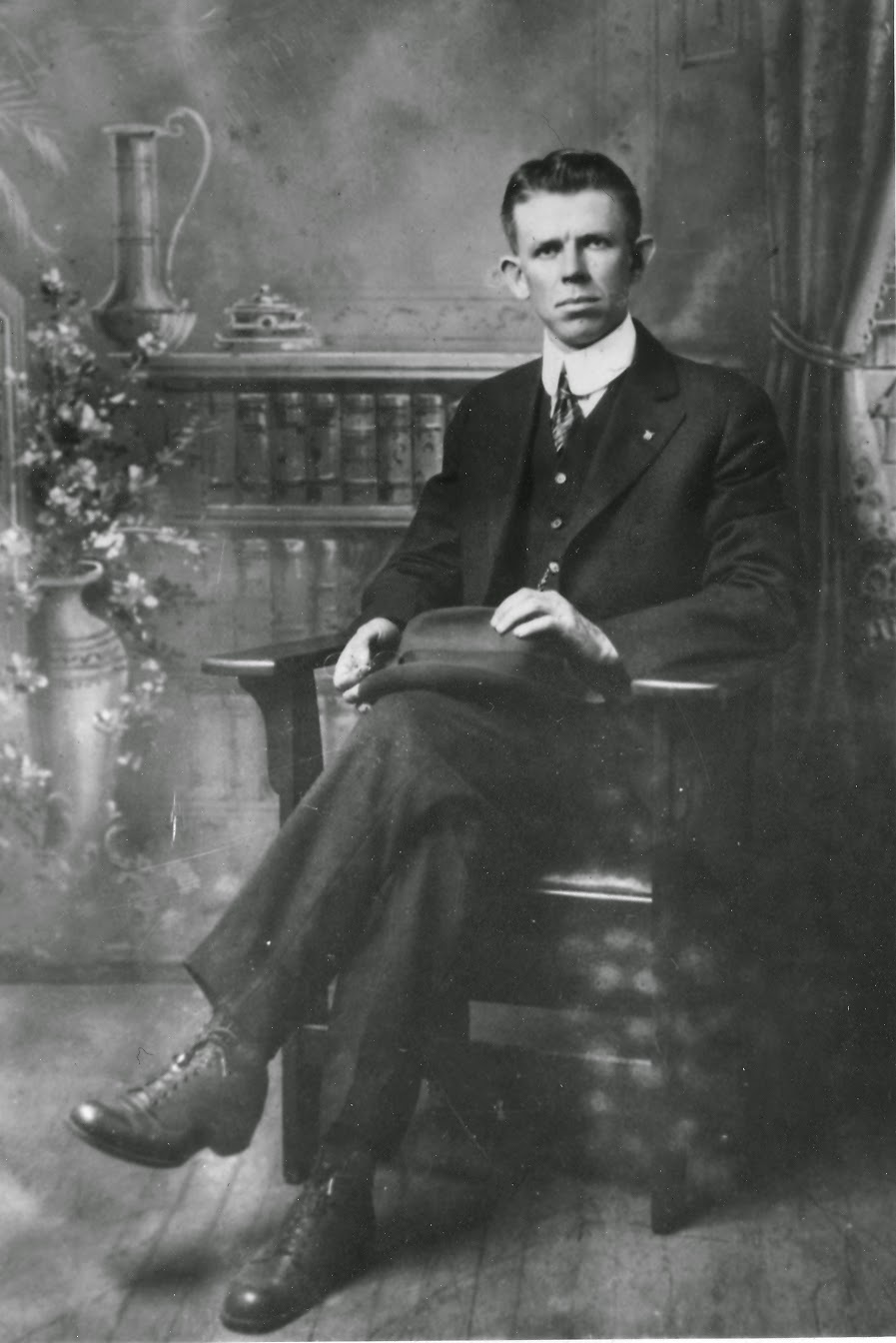
My paternal great-grandfather, Daniel Asa Smith (1867 – 1955), was always a snappy dresser. My father said that part of his success as a huckster was that he dressed to impress the ladies of the town who bought his goods.

Daniel Asa Smith in the 1930s.
For that reason I had to laugh when I read his father’s will, written in 1903. It may be that Daniel Asa came by his interest in clothes naturally.

Wills generally follow a standard pattern. They may open with an extended paragraph that includes an expression of faith, appreciation for the life that has been lived, their love for their spouse, their fitness to make a will, and a revocation of any previous wills. Language may be very flowery and expressive. This is followed by another paragraph with directions for the executor to pay off debts and any specific directions for funerals and associated expenses.

They then deal with real property and large bequests. Finally, they discuss smaller personal property bequests.

Not so the will of William E. Smith (1824-1903), Daniel’s father.
William E Smith

The first brief sentence of his will sets forth his fitness to write a will and revokes all former wills.

The second brief sentence contains standard language regarding payment of debts.

The third sentence stands alone and says: 

All my wearing apparel I direct to be equally divided 
between my sons C. W., Abraham, D. A., W. A., and Dennis E.

Only then does he go on to disburse, in businesslike terms, the rest of his somewhat extensive holdings.

I guess maybe his clothes were so much in demand that it would cause a rift among his sons? He must have had quite a wardrobe if it was to be divided among five grown men!

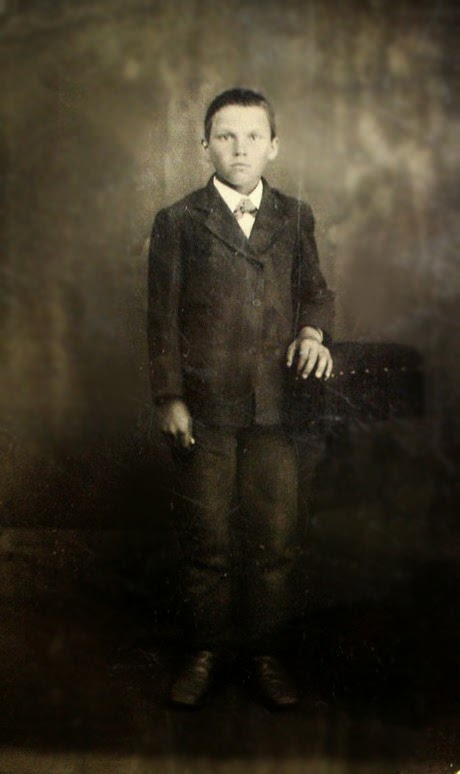
D A Smith age 14, ca 1881